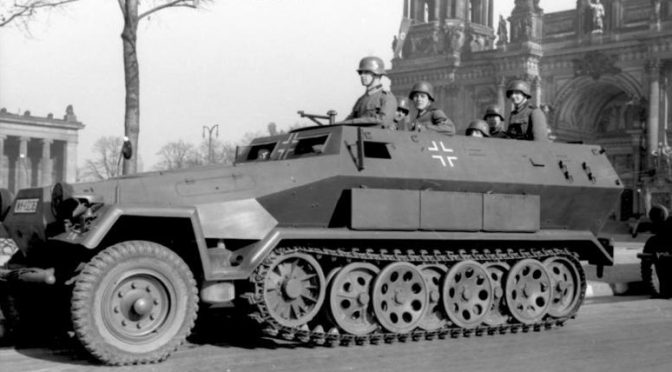
The Sd.Kfz. 251 (Sonderkraftfahrzeug 251) half-track was a WW2 German armored fighting vehicle designed by the Hanomag company, based on its earlier, unarmored Sd.Kfz. 11 vehicle. The Sd.Kfz. 251 was designed to transport the panzergrenadiers (German mechanized infantry) into battle. Sd.Kfz. 251s were the most widely produced German half-tracks of the war, with at least 15,252 vehicles and variants produced by various manufacturers, and were commonly referred to simply as "Hanomags" by both German and Allied soldiers.
The early production models of this vehicle were issued to the 1st Panzer Division in 1939.
These vehicles were meant to enable panzergrenadiers to accompany panzers and provide infantry support as required. In practice, there were never enough of them to go around, and most panzergrenadier units had to make do with trucks for transport.
There were four main model modifications (Ausführung A through D), which formed the basis for at least 22 variants.[1] The initial idea was for a vehicle that could be used to transport a single squad of 10 panzergrenadiers to the battlefield protected from enemy small arms fire, and with some protection from artillery fire. In addition, the standard mounting of at least one MG 34 or MG 42 machine gun allowed the vehicle to provide suppressive fire for the rifle squad both while they dismounted and in combat.
The armour plates were designed to provide protection against standard rifle/ machine gun bullets (like the 7.92×57mm Mauser bullet). The front-facing plates were 14.5mm thick; the sides were steeply angled, V-shape 8mm thick plates. This level of armour provided protection against normal (non-tungsten) rifle AP round, which could pierce about 8mm of vertical armour.
Positive aspects of the open top included greater situational awareness and faster egress by the infantry, as well as the ability to throw grenades and fire over the top of the fighting compartment as necessary while remaining under good horizontal cover. The downside was a major vulnerability to all types of plunging fire; this included indirect fire from mortars and field artillery, as well as small arms fire from higher elevated positions, lobbed hand grenades, even Molotov cocktails, and strafing by enemy aircraft.
The first two models (ausf A and B) were produced in small numbers from 1939. Ausf A and B models can be identified by the structure of the nose armor, which comprised two trapezoidal armor panels - the lower of which had an engine cooling vent. The B model, which began production in 1940, eliminated the fighting compartment's side vision slits. The C model, which started production in mid-1942, featured a simplified hexagonal-shaped forward armored plate for the engine. Models A through C had rear doors that bulged out. The C model had a large production run, but was quite complex to build, involving many angled plates. From early 1943, the D model was developed with the purpose of halving the number of angled body plates, simplifying the design and thus speeding up the production. D models can be easily recognized by their single piece sloping rear, with flat doors.
The standard personnel carrier version was equipped with a 7.92 mm MG 34 or MG 42 machine gun mounted at the front of the open compartment, above and behind the driver. A second machine gun could be mounted at the rear on an anti-aircraft mount.
Variants were produced for specialized purposes, including with anti-aircraft guns, light howitzers, anti-tank guns and mortars or even large unguided artillery rockets, as well as a version with an infrared search light used to spot potential targets for associated Panther tanks equipped with infrared detectors.
A strong design feature of the Sd.Kfz.251 was the large track area, with the characteristic "slack track" design with no return rollers for the upper run of track. The SdKfz 251 also had the Schachtellaufwerk system of overlapping and interleaved main road wheels common to virtually all German halftracks of the period. This lowered the ground pressure and provided better traction, at the cost of much greater complexity in maintenance. The 251 also had tank steering, whereby the normal steering wheel moved the front wheels, but after more turning of the steering wheel, the tracks are braked to cause turning, like on a tank. However, the interleaved and overlapping main road wheels shared a major problem with the Tiger I and Panther tanks that also used such roadwheel configurations - in muddy or winter weather conditions, such as those during a mud season (rasputitsa) or the winter conditions, accumulated mud and snow could freeze solid between the road wheels, immobilizing the vehicle.
8.8 cm Flak 36
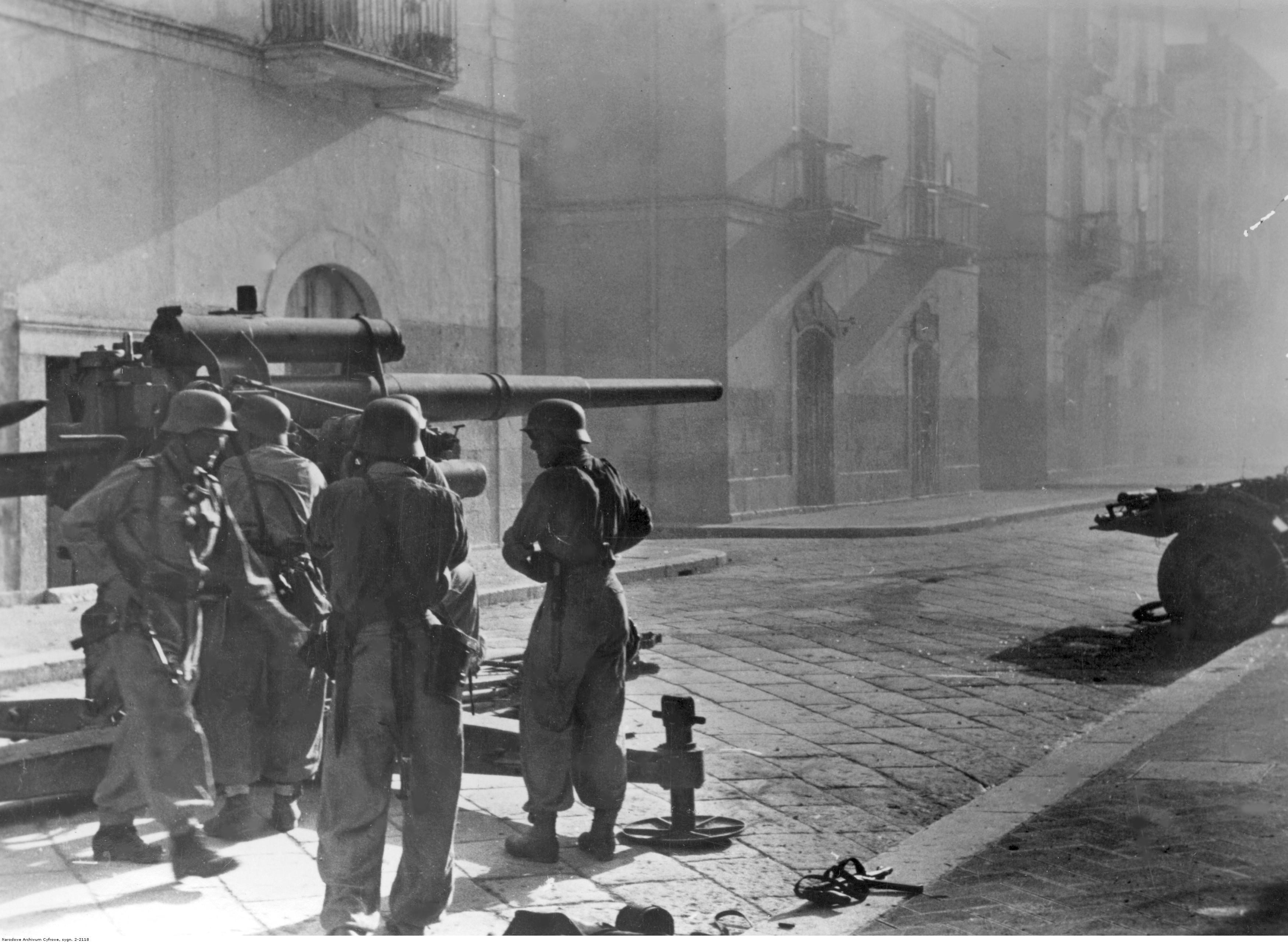
The 8.8 cm Flak 18/36/37/41 was a German 88 mm anti-aircraft and anti-tank artillery gun from World War II. It was widely used by Germany throughout the war, and was one of the most recognized German weapons of that conflict. Development of the original model led to a wide variety of guns.
The name applies to a series of related guns, the first one officially called the 8.8 cm Flak 18, the improved 8.8 cm Flak 36, and later the 8.8 cm Flak 37.[N 1] Flak is a contraction of German Flugzeugabwehrkanone[4][N 2] meaning "aircraft-defense cannon", the original purpose of the weapon. In English, "flak" became a generic term for ground anti-aircraft fire. In informal use, the guns were universally known as the Acht-acht ("eight-eight") by Germans and the "eighty-eight" by the Allies.[N 3]
The versatile carriage allowed the 8.8 cm FlaK to be fired in a limited anti-tank mode when still on its wheels;[3] it could be completely emplaced in only two and a half minutes.[3] Its successful use as an improvised anti-tank gun led to the development of a tank gun based upon it: the 8.8 cm KwK 36, with the "KwK" abbreviation standing for Kampfwagen-Kanone (literally "battle vehicle cannon", or "main battle tank cannon"), meant to be placed in a gun turret as the tank's primary armament. This gun served as the main armament of the Tiger I heavy tank.
In addition to these Krupp designs, Rheinmetall later created a more powerful anti-aircraft gun, the 8.8 cm Flak 41,[N 1] which was produced in relatively small numbers. Krupp responded with another prototype of the long-barreled 8.8 cm gun, which was further developed into the anti-tank and tank destroyer 8.8 cm PaK 43 gun used for the Elefant and Jagdpanther, and turret-mounted 8.8 cm KwK 43 heavy tank gun of the Tiger II
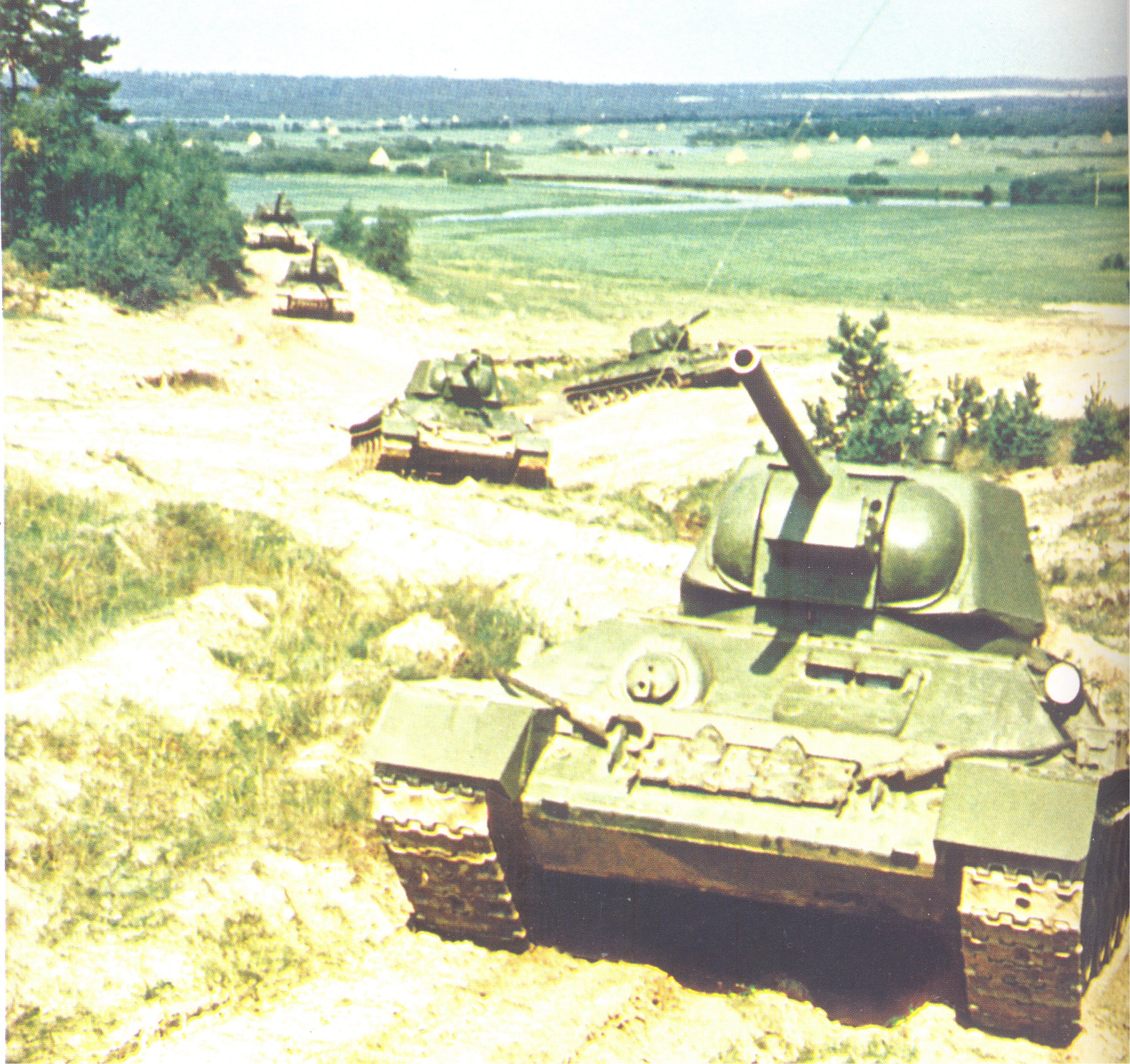
T-34
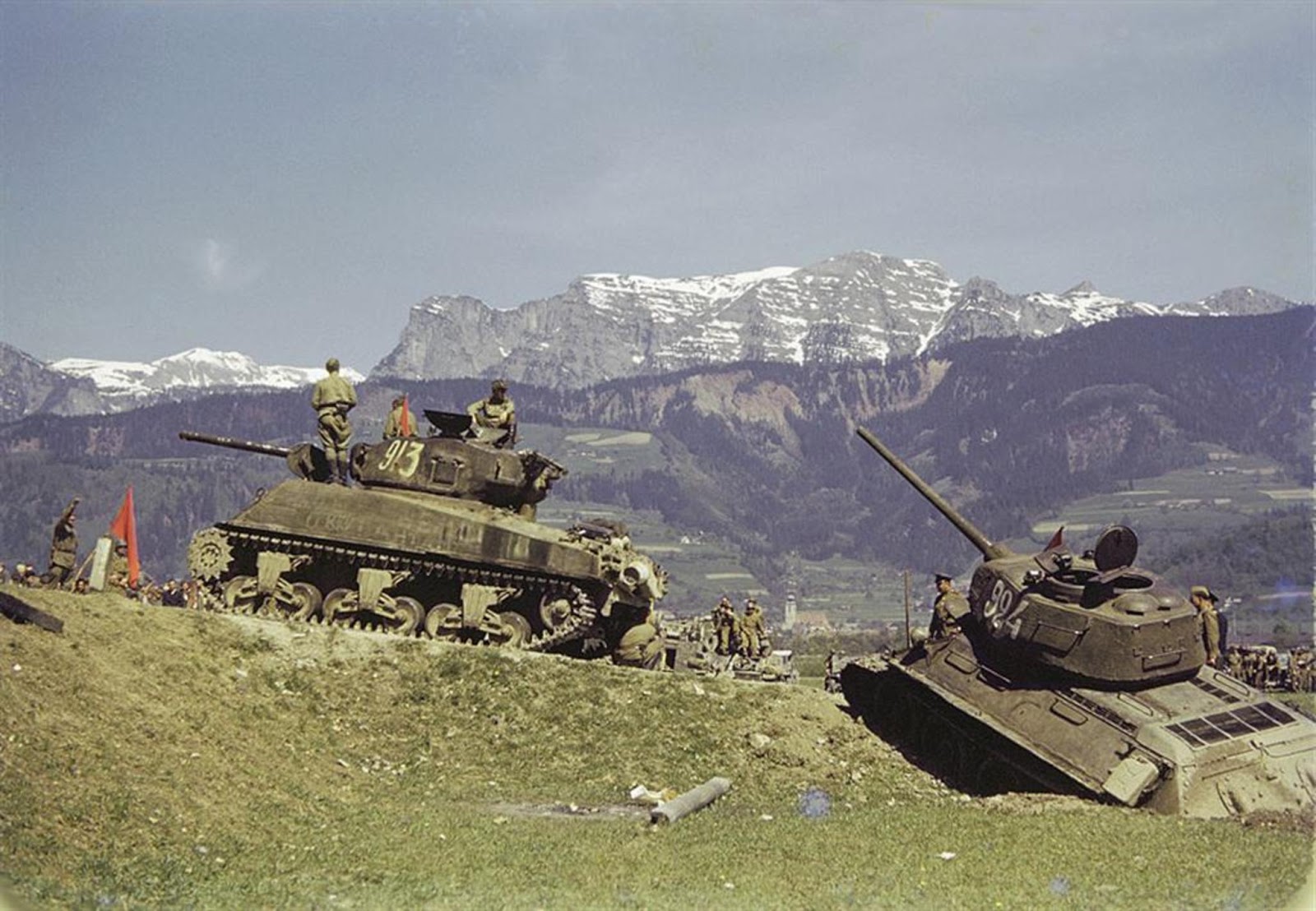
OThe T-34 is a Soviet medium tank that had a profound and lasting effect on the field of tank design. At its introduction, the T-34 possessed an unprecedented combination of firepower, mobility, protection and ruggedness. Its 76.2 mm (3 in) high-velocity tank gun provided a substantial increase in firepower over any of its contemporaries;[5] its well-sloped armour was difficult to penetrate by most contemporary anti-tank weapons. When first encountered in 1941, German general Paul Ludwig Ewald von Kleist called it "the finest tank in the world"[6] and Heinz Guderian affirmed the T-34's "vast superiority" over existing German armour of the period.[7][8] Although its armour and armament were surpassed later in the war, it has often been credited as the most effective, efficient and influential tank design of the Second World War.[9]
The T-34 was the mainstay of Soviet armoured forces throughout the Second World War. Its design allowed it to be continuously refined to meet the constantly evolving needs of the Eastern Front: as the war went on it became more capable, but also quicker and cheaper to produce. Soviet industry would eventually produce over 80,000 T-34s of all variants, allowing steadily greater numbers to be fielded as the war progressed despite the loss of tens of thousands in combat against the German Wehrmacht.[10] Replacing many light and medium tanks in Red Army service, it was the most-produced tank of the war, as well as the second most produced tank of all time (after its successor, the T-54/55 series).[11] At 44,900 losses during the war, it also suffered the most tank losses of all time.[12] Its development led directly to the T-54 and T-55 series of tanks, which in turn evolved into the later T-62, T-72, and T-90 that form the armoured mainstay of many modern armies. T-34 variants were widely exported after World War II, and in 2010 the tank remained in limited frontline service with several developing countries.[13]